The Key to this is Monopoly

New Media Studies is a very broad field of study; its students could end up just wondering through different classes without really creating a coherent set of skills for themselves. In order to avoid that, my professor challenged us to critically examine our plans for our time here at DePaul and present them creatively, by drawing a map.

Here’s a good time for me to make a confession. I am NOT creative. The simplest of creative tasks are usually quite challenging for me, so I’m quite proud of the creative spurt I had during this class.
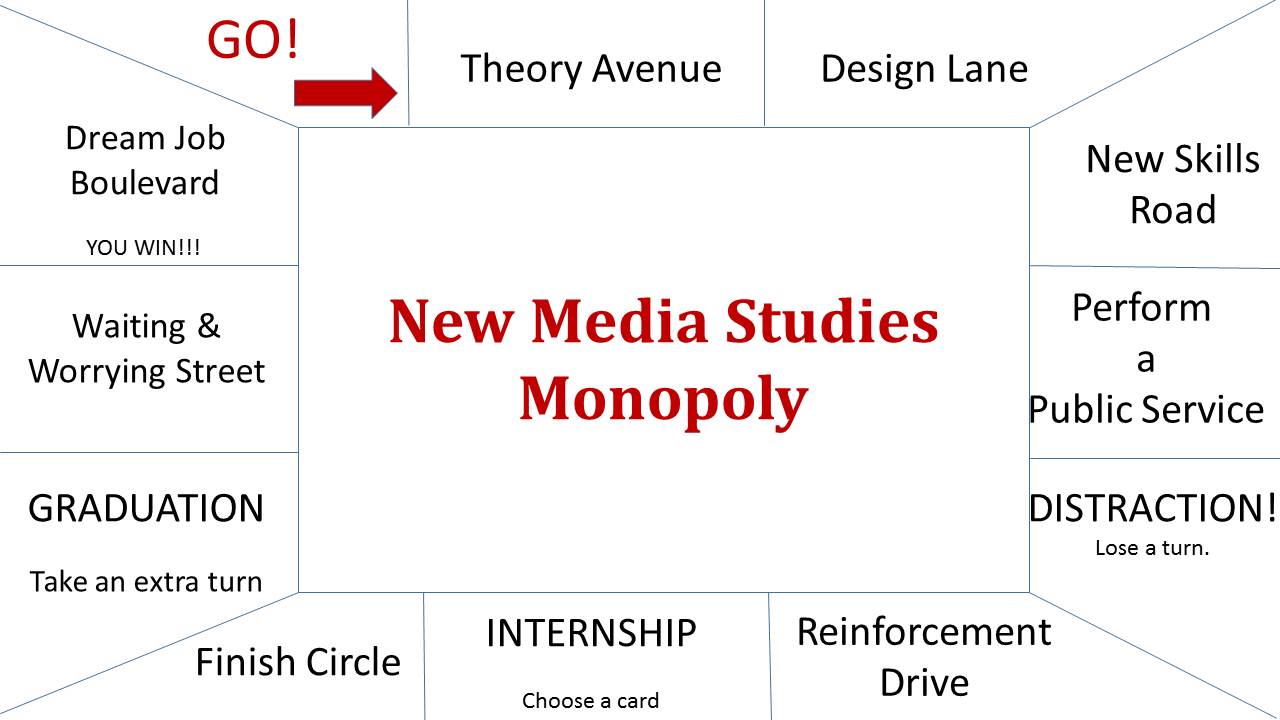
An example of a plan of courses and skills for a student of new media studies

The Monopoly inspired plan I created for my Proseminar class. Please click to enlarge.

I was inspired by my favorite childhood board game, Monopoly. I turned each cluster of classes or skills into a square on the board. All the squares were given names based the cluster it represented plus a street, drive, circle, boulevard, etc. in in order to go along with the names of properties in Monopoly. It also includes a “DISTRACTION!” square which is the equivalent of jail and Internship and Graduation squares which are similar  to chance. Of course, I gave the Dream Job Boulevard the same space as the most coveted Boardwalk in the real game.

When I shared my design with the class a few of my colleagues found it interesting, so I thought I would share it here as well. My classmate Robert, of Robert’s Hilarious Design Blog, said the Monopoly game was a good idea because life is like it, a mix of good and bad.

I’m so glad for this assignment. It really helped me see exactly what my goals are. After feeling like I spent the entirety of my undergraduate career confused, clarity is a beautiful thing.

Drawing a Blank… I forget everything

So of course the week I volunteer to be one of the class discussion leaders I have nothing. The reading was not cool or interesting and I had the hardest time coming up with something dynamic to engage my class. Yay for me! The following is my attempt at questions to stimulate the discussion my class will have later:

Before reading this I had never thought of the computer as an encyclopedia, but now more than ever we turn to our computers whenever we have questions. Nine out of ten conversations I have with my mother at some point one of us says, “let’s just google it.” Our computers remember everything for us. I know only two phone numbers by heart, my mother’s and my grandmother’s. I have hundreds of numbers stored in my phone though. Not just phone numbers but email addresses and physical addresses as well. I don’t even try to remember things anymore. I just store them on my computer and go on with my day.

Do our computers allow us to forget everything?

In a different class we talked about the idea of trust. We just trust that our machines and networks will work properly although we don’t really understand how they work or know how to repair them if the malfunction. A primary example is an ATM. We simply trust that the ATM and its network will just know that we deposited $200 and our online bank account will reflect.

Do we trust these machines to remember forever?

We know these. They're all over campus. And when we see them we assume that when we use them they will work.

We know these. They’re all over campus. And when we see them we assume that when we use them they will work.

What happens on that God forsaken day when we wake up and the computers have decided to forget everything too?

The Key to this is Awareness

Last week, my best friend and I attempted to have a conversation via text, nothing serious just some gossip about a mutual acquaintance being pregnant, and I was having a complete slow moment; my brain just was not comprehending what she was typing. Finally, she just gave up and called me. We ended up talking for at least an hour and it was enjoyable but I kept trying to check Facebook, Twitter, and email while she was talking to me.

I had to tell myself to stop it, just be in this moment, this phone conversation, and be ok with it.

On this journey with new media, I’m becoming much more aware of my use of computers and the Internet. Author, Howard Rhiengold asks his readers to do the same thing the excerpt my class is reading this week from his book, Net Smart: How to Thrive Online. We are not as good at dividing our attention as we think. In our attempt to remain connected to everyone, the whole world, we are starting to lose a grip on those closest to us. I noticed the same thing happening to me. My relationships with those I cannot text or Facebook, mainly my older relatives, falter greatly. Rhiengold also talks about his students using devices in class and how it bothers him; he knows he doesn’t have their full attention. It reminded me that I used my computer and phone during class. There are only six of us in there!

Where do I get the gall to just go off somewhere on my phone or computer in the middle of a class?

Finishing up Turkle’s Alone Together made me think about how I could be more healthy about my use of media in my life. She tells the story of a young man named Brenden who does not like to text because it cannot relay all the nuances of face- to-face communication. His need for face-to-face communication bothers his friends and girlfriend. But why do the people that claim to love him not want to talk to him? Why are they so picky about format? I thought that was unfair of them. After noticing these events I’ve decided that more telephone calls are in my future, less text messages. More house calls, less Facebook messages.

Even if I’m not totally unsuccessful, more “physical real” is good for me. If nothing else it will make me more aware of what is happening around me. I won’t misunderstand my friends text. I won’t space out during lunch with a friend. I will hear the entirety of my professor’s lecture.

This week I am determined to live in the physical real. No compromises.